Gansu 8D7N Tour Itinerary
Itinerary A:
Schedule:
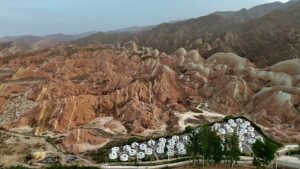
Morning: Sight viewing of the multicoloured hilly landform
Noon: Sight viewing of the Bing Gou Dan Xia landform
Afternoon/Night-time: Departure from Zhangye Railway Station/Zhangye West Railway Station/Ganzhou Airport/Linze South Railway Station/Linze Station
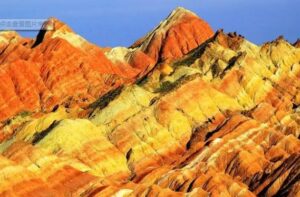
Info: Multi-coloured Hilly Landform (Walk 600m to the right of Drachmay)
Located in the middle of Gansu Porvince’s Hexi Corridor, Zhangye is one of the four ancient Hexi counties. The beautiful name “Zhangye” stands for “opened arms of China and opened door to the western regions”. Zhangye’s signature multicoloured hilly landform is a mountainous and hilly area with a size of 100 square kilometres. It is mostly renowned for its peculiar shape, various colour, and magnificent size. The landform is composed of a kind of red sandstone, with various isolated peaks and steep rocks as a result of long-term weathering and erosion. The formulation of this type of landform can be dated back to 200,000 years ago during the Jurassic period.
Business Hours: 05:30AM — 19:00PM
Ticket Price: 93 CNY/person
Recommended Visiting time: 3 hrs
Info: Bing Gou Dan Xia Landform (14 kilometers from Drachmay)
Xhangye Danxia National Geological Park is mainly divided into the Bing Gou Landform scenic spot and the Multi-coloured Hilly Landform scenic spot. Bing Gou is the most typical hilly landform in the area areas of China. It is famous for its grandness, danger, and magic. Walking in the geological park, you will witness the most magnificent masterpiece of nature, exploring its aesthetic and scientific significance.
Business Hours: 07:00AM — 18:00PM
Ticket Price: 60CNY/person
Recommended Visiting Time: 2.5 hrs
Itinerary B:
Morning: Sight viewing of the Bing Gou Dan Xia Landform
Noon: Mati Temple
Afternoon/Night-time: Big Buddha Temple à Departure from Zhangye Railway Station/Zhangye West Railway Station/Ganzhou Airport/Linze South Railway Station/Linze Station
Info: Bing Gou Dan Xia Landform (14 kilometers from Drachmay)
Xhangye Danxia National Geological Park is mainly divided into the Bing Gou Landform scenic spot and the Multi-coloured Hilly Landform scenic spot. Bing Gou is the most typical hilly landform in the area areas of China. It is famous for its grandness, danger, and magic. Walking in the geological park, you will witness the most magnificent masterpiece of nature, exploring its aesthetic and scientific significance.
Business Hours: 07:00AM — 18:00PM
Ticket Price: 85CNY/person
Recommended Visiting Time: 2.5 hrs
Info: Mati Temple (93 kilometers from Drachmay; approximately 2-hour drive)
Located in the area of Sunan Yugu Autonomous County, Mati Temple is a tourist site integrating the art of grottoes, the scenery of Qilian Mountain and the customs of the Yugurs. The 70 grottoes were built in Beiliang, consisting of Shengguo Temple, Puguang Temple, Thousand Buddha Cave, Jinta Temple, and the upper, middle and lower Guanyin Caves. The Mati Cave is a large-scale grotto group. It includes seven small grottoes that are nearly 30 kilometers long, and is a state-level cultural relics protection unit.
The name of the temple “Mati” translates into horseshoes. According to folklores, when the horses fell on a rock here, they stepped on a hoof print, and the temple was thus named after it.
Dafo Temple (58 kilometers from Mati Temple; approximately 1-hour drive)
Located in the southwest corner of Zhangye City, Gansu Province, Dafo Temple was built in the first years of Yongan, a Xixia dynasty. This Scenic Spot is an important historical and scenic group on the Silk Road. It is also the landmark building of the historical and cultural city of Jin Zhangye. The scenic spots opened to the public are the Big Buddha Temple built in Xixia, the Wanshoumu Pagoda in the Sui Dynasty, the Amitabha Thousand Buddha Tower in the Ming Dynasty, the Bell and Drum Tower, and the Shanxi Guild Hall in the Qing Dynasty.
The temple houses the largest indoor reclining Buddha in the country, which is the Nirvana image of Buddha Sakyamuni. He sleeps peacefully above the 1.2-meter-high Buddhist altar in the main hall. The Buddha is 34.5 meters long, shoulders 7.5 meters wide, ears about 4 meters long and 5.2 meters long. A middle finger of the Buddha can lay a person flat, and eight people can sit side by side in the ear, showing how huge the statue is.
Itinerary C:
Morning: Sight viewing at Pingshan Lake Valley
Noon: Zhangye Wetland Park
Afternoon/Night-time: Departure from Zhangye Railway Station/Zhangye West Railway Station/Ganzhou Airport/Linze South Railway Station/Linze Station
Info: Pingshan Lake Valley (94 kilometers from Drachmay; approximately 2-hour drive)
Ping Shan Lake Valley is about 60 kilometers away from Zhangye City, and is 1500 to 2550 meters above sea level. Its so-called “red layer” form refers to the red rock series formed during the Mesozoic Jurassic to Cenozoic Tertiary sediments, commonly referred to as “red glutenite”. The gorge is characterized by flowing gully, and the mountain is low and gentle, with the sandstone mountain as the background.
The landform’s colour is mainly red, white and blush with a slightly gray tone. The shape is mostly conical or clunmnar, which is extremely irregular and peculiar. The width is between 2 km and 15 km. The two sides of the gorge are high in the north and low in the south. This special geomorphic feature is formed by billions of years of crustal uplift, natural wind erosion, water erosion and chemical dissolution. During the erosion period, the harder rock formations in the plateau constitute the protrusions between the valleys and the erosion in the valleys.
Pingshan Lake Valley has been credited by China Geography Magazine and famous geologists and tourists at home and abroad as “the Zhangjiajie of Northwestern China” and “The Grand Canyon of China” and the “new discovery on the Silk Road”.
Business Hours: 07:00AM — 18:00PM
Ticket Price: 130CNY/person
Recommended Visiting Time: 2.5 hrs
Info: Zhangye Wetland Park (42 kilometers from Drachmay; approximately 1-hour drive)
Zhangye National Wetland Park is located in the northern suburbs of Ganzhou District, Zhangye. Occupying the northern urban groundwater spill-over zone, the park is 62,000 mu large, and is the nearest Wetland Park to the city in China.
The functional structure of the park is “two cores and one axis”, of which “one axis” refers to the wetland plank road boutique tour line that runs through the Nanhu Visitor Center to the North Lake Bird Science Popularization Gallery; “Two Cores” refers to the two formed by the South Lake and the North Lake. The core of the tourist site is surrounded by the lake area for leisure, adventure, sports, games, science, viewing, photography, painting and other tourist functional areas.